


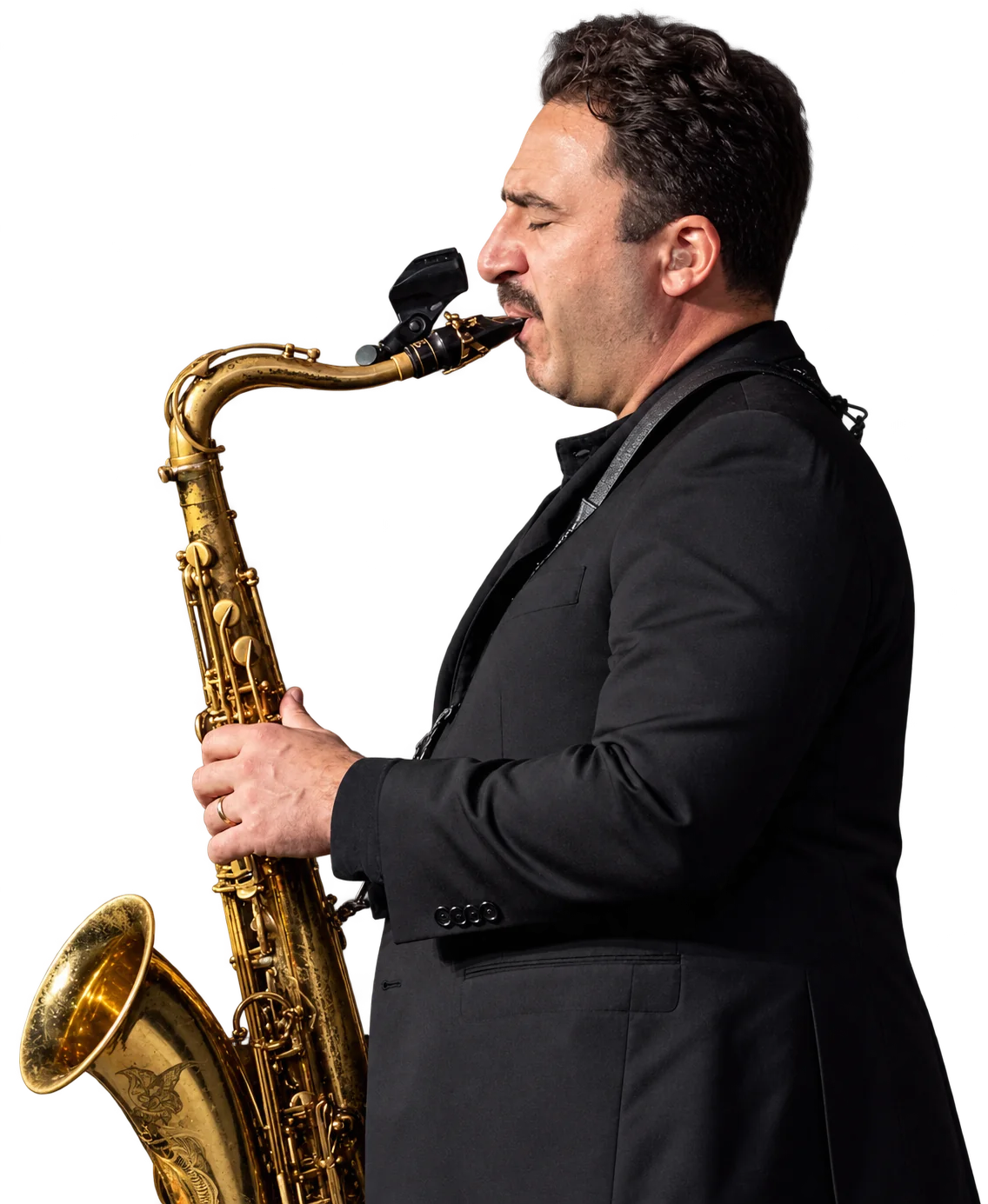
Growing up around working musicians
Anthony Bruno’s musical life began in a family where rehearsals, club appearances, and festivals were ordinary parts of the week. His father played saxophone, and his siblings also learned instruments. As a child, Bruno accompanied his father to the places musicians worked, gaining an early sense of performing as both a craft and a job. He started his first band at thirteen and found that playing for a crowd appealed to him as much as the instrument itself.
The music at home included Motown, R&B, and hip-hop. Jazz became a more concentrated interest during college, when he began studying the work of Sonny Rollins, John Coltrane, Wayne Shorter, and Joe Henderson. His later music retains both strands: the melodic and rhythmic directness of the records he grew up with and the improvisational possibilities he found in jazz. He has also spoken of punk and emo music as influences on the emotional character of his writing.
A saxophonist with a wider palette
Tenor saxophone is Bruno’s principal instrument, but his musical activities extend to alto and soprano saxophones, flute, clarinet, bass, and drums. He began playing drums at fourteen in order to form a punk band, and returned especially closely to clarinet during the pandemic. The different instruments give him ways to think about melody, rhythm, and arrangement from inside an ensemble rather than only from its lead voice.
In his 2024 All About Jazz interview, Bruno described his preference for a full, vocal quality of tone and melodies he could sing. Rollins mattered to him not simply for technical command, but for rhythmic freedom, humor, and the sense of a recognizable person coming through the horn. Michael Brecker was another saxophonist whose intensity and warmth he admired. These are useful guides to Bruno’s own priorities: a substantial sound, clear melodic identity, and an expressive relationship with the band.
His Chicago work has included appearances with the Temptations, the Four Tops, Wynton Marsalis, Larry Carlton, and other visiting and local artists. Those engagements sit alongside his own groups rather than replacing them. His manufacturer biography identifies jazz, Afro-Cuban music, and R&B as foundations of his musical language, a range reflected in the variety of situations in which he performs.
Building an original recording career
Bruno’s releases before his first full-length self-titled album included On the Rocks, Stilo, Celestial Affair, and Logan Steps. The sequence traces an expanding catalog under his own name, with the artist’s Bandcamp listing dating those titles from 2020 through 2022. He has singled out ‘Celestial Affair’ as a recording with a particular personal appeal, while continuing to write new material for a working band.
Anthony Bruno appeared in 2023. Its release helped bring his group into regular Chicago engagements, including Dorian’s and Andy’s Jazz Club, as well as festival appearances. Vocalo featured ‘Thankful for You’ in its September 2023 Poised to Break Through selections. In conversation with the station, Bruno described composing at the piano and hearing the completed ensemble arrangement only when the musicians began playing together. Melody remained a central concern even when the emotional starting point was difficult or unsettled.
Cefalù followed in May 2024, with James Russell Sims on drums, Cole Runge on guitar, Andrew Lawrence on keyboards, and Vinny Kabat on bass. Its geography is partly imagined: Bruno has explained that places he has never visited can be starting points for music. Titles including ‘Buenos Aires,’ ‘La Boca,’ ‘Guadalajara,’ and ‘Uruguay’ make that interest explicit. Other selections, such as ‘Free Me,’ ‘Sunday Sun,’ and ‘Farewell,’ give the ten-track program a more personal vocabulary alongside its place names.
Blue Velvet and the performing band
Blue Velvet arrived in 2025, following the self-titled album and Cefalù as a third consecutive annual release. The quintet includes Sims and Kabat, with Matt Gold on guitar and Julius Tucker on piano, keyboards, and synthesizers. Its eight selections include ‘Bread and Circus,’ ‘For Biggs,’ ‘February,’ ‘The Tease,’ and ‘Together.’ Changing the chordal instruments’ players while retaining the bass-and-drums partnership gave this record a different configuration within the continuing project.
Reviewing the album for All About Jazz, Dan McClenaghan emphasized the interaction of guitar and keyboards and the way the ensemble’s parts fit together. He also heard Bruno’s Rollins influence in the energy and R&B coloring. That response locates Bruno within an accessible, groove-conscious jazz tradition while recognizing that the band arrangement is central to the result. The records are built as group performances, with more going on than a saxophone placed over anonymous accompaniment.
Bruno’s activity also reaches beyond that quintet. A 2025 interview with John Chacona described his work with the nine-piece horn band New Nostalgia and a quartet engagement in Cleveland with Noah Sherman, Kevin Martinez, and Theron Brown. Bruno explained the importance of choosing players comfortable with several kinds of music. He also stressed entertainment: a concert should create a memorable experience for the people who have made time and paid to attend.
Teaching and musical connection
Bruno’s educational work includes serving as music department head and jazz chair at the Chicago High School for the Arts. His teaching responsibilities have included saxophone technique, jazz combo, and big band. Working with young musicians gives him another sustained ensemble setting, one in which the process of discovering music matters alongside the finished performance.
He has described his first teaching priority as helping students become interested enough to direct their own learning. That approach connects to his own history of starting bands, exploring additional instruments, and learning through different musical situations. His contribution to Chicago’s music life therefore includes the students he helps prepare as well as his own recordings and club engagements. Both depend on the continuing relationship between individual expression and the people making music together.
The continuity from Cefalù to Blue Velvet is especially apparent in the personnel: Kabat and Sims remain the bass-and-drums partnership while Gold and Tucker replace the earlier guitar-and-keyboards combination. Bruno can therefore build new arrangements around musicians already familiar with his writing while introducing different instrumental voices. The records present a developing band concept over successive releases, with both personnel changes and continuing relationships shaping the music.