


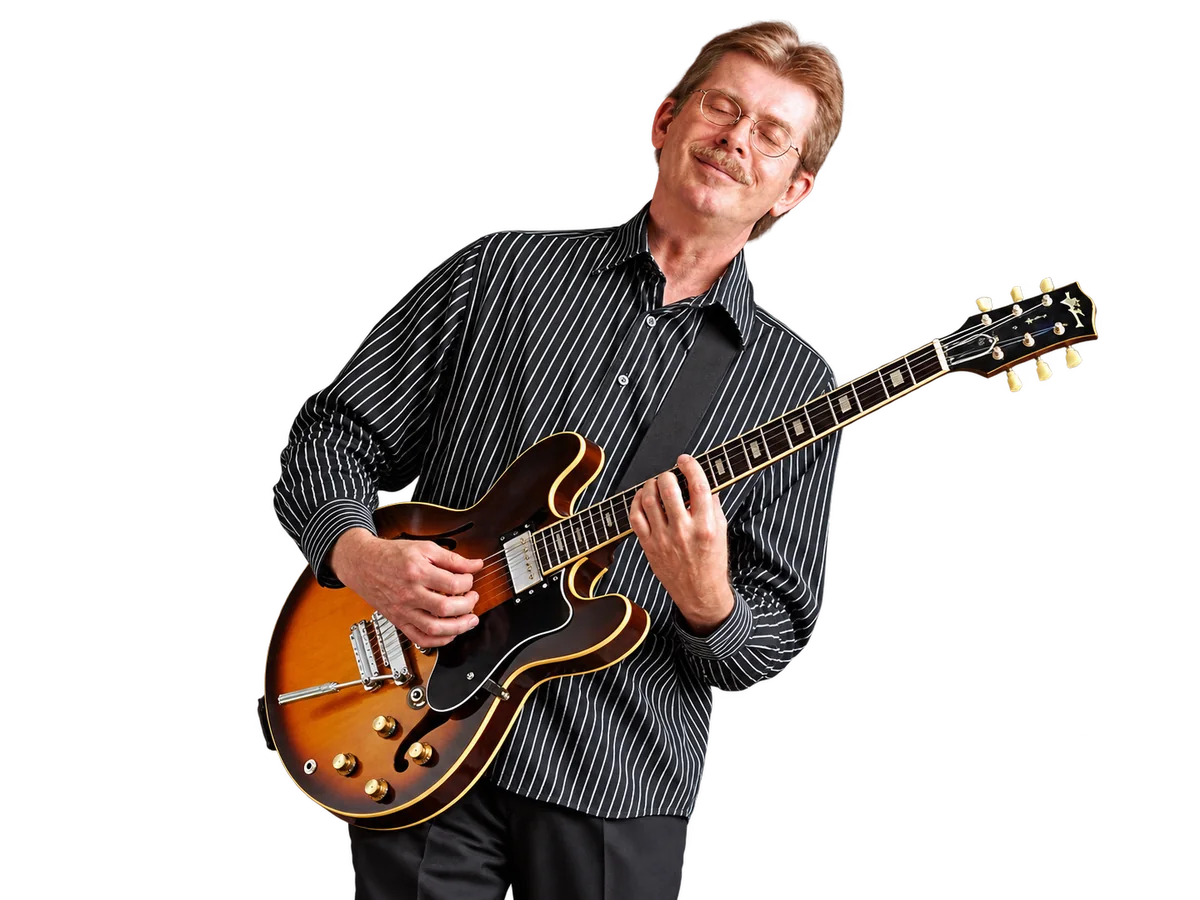
A Green Bay education in records and live music
Born in Green Bay, Wisconsin, in 1956, Billy Flynn learned music by ear and through persistent curiosity. He played ukulele before a full-size guitar suited his hands, bought an inexpensive acoustic instrument with his own money, and later acquired an electric guitar. Drums were part of his early experience too: as a teenager he played in garage groups, including the Blues Express. Records by Chuck Berry, B.B. King, Fats Domino, Bo Diddley, and Muddy Waters supplied a broad education in the relationship between melody, rhythm, and a singer’s delivery.
The Ventures’ “Walk Don’t Run” opened another avenue. Flynn listened repeatedly to the details of surf guitar, finding that a seemingly straightforward instrumental contained more intricate construction than it first suggested. Acoustic blues brought further interests, including Tampa Red, Big Bill Broonzy, Lightnin’ Hopkins, Lonnie Johnson, and Robert Nighthawk. Those enthusiasms help explain why he later worked comfortably on different stringed instruments and in contrasting band settings. His grounding in traditional blues developed alongside an appreciation of instrumental music, rather than through a rejection of everything outside one narrow style.
Jimmy Dawkins and the musicians who welcomed him
Flynn’s introduction to Jimmy Dawkins began when he was too young to enter a Green Bay club. Waiting outside with a guitar, he encountered Dawkins’ drummer Lester Dorsey, who helped arrange permission for him to sit in. Dawkins subsequently became a mentor and employer, inviting him into his band while Flynn was still a teenager. Flynn stayed at Dawkins’ home during visits to Chicago, and their friendship lasted until Dawkins’ death in 2013. They played together at Dawkins’ final public appearance at the Smoke Daddy.
Other visiting musicians supplied different lessons. John Littlejohn’s clear slide tone impressed Flynn, as did his ability to move beyond slide into single-string playing. Mighty Joe Young welcomed him onstage and offered an example of both effective second guitar and steady bandleading. Encounters with Luther Allison and conversations with B.B. King widened the education. Flynn has repeatedly described these musicians as approachable working people. Their willingness to answer questions became a model for his own dealings with younger players: learning required attentive listening, but also the confidence to ask how a passage or sound was made.
A career built around other people’s songs
Flynn became a regular choice for musicians who needed a guitarist able to understand a particular blues vocabulary without crowding it. His employers and recording partners have included Sunnyland Slim, Mississippi Heat, the Legendary Blues Band, Kim Wilson, Jimmy Burns, Billy Boy Arnold, Jody Williams, Lurrie Bell, Pinetop Perkins, and the Cash Box Kings. The range matters because these artists do not all ask for the same sound. Accompaniment can require a compact rhythmic figure, sustained notes beneath a vocal, or a different attack when a harmonica takes the lead.
His partnership with Barrelhouse Chuck was especially productive. Chuck estimated in a 2014 interview that they had played more than thirty sessions together. On Driftin’ from Town to Town, Flynn joins Kim Wilson, Larry Taylor, Richard Innes, Jeremy Johnson, and Sax Gordon in an ensemble assembled around Chuck’s piano. Their shared experience helps explain the speed and ease Chuck recalled from the recording. Flynn’s ability to recognize a song’s character quickly made him valuable in exactly this kind of gathering, where musicians could shape a performance without prolonged explanation.
Film work and Lonesome Highway
Flynn’s session work also reached a much larger audience through Cadillac Records. He contributed guitar to the film’s music, including the Etta James material performed by Beyoncé and the Chuck Berry character’s “Surfin’ U.S.A.” He backed Beyoncé at Barack Obama’s Neighborhood Inaugural Ball, and his work appears on her Grammy-winning recording of “At Last.” These engagements grew from his command of specific musical idioms. Playing a recognizable style convincingly for a film or singer requires decisions about tone, attack, and economy, not simply the ability to reproduce a fast solo.
Lonesome Highway, his first album as a leader for Delmark, appeared in 2017. It followed a substantial independent recording history and put his singing and songwriting beside the guitar work for which he was already known. The program includes the title song, “Good Navigator,” “The Lucky Kind,” and “The Right Track,” with Deitra Farr among the guests. Reviews singled out the title track’s West Side character, his use of chords as well as single-note lines, and the variety within the set. The album received a Blues Blast nomination for traditional blues album.
The record also leaves room for instrumentals, including “The ‘In’ Crowd,” and for the seasonal “Christmas Blues.” Flynn’s move between a melodic instrumental and a sung blues reflects the breadth of the music he had collected since childhood. His harmonica and percussion contributions expand his role further. With producer Dick Shurman overseeing the project, the album presents the parts of his musicianship that an individual sideman date might leave out: the choice of repertoire, the sequencing of contrasting moods, and the responsibility for keeping an entire program coherent.
Freelance work, local roots, and a wide musical range
Despite his close Chicago connections, Flynn remained based in Green Bay for much of his career. He and his wife Mary organized the Blues in the Park concert series for nearly three decades, bringing touring musicians to Wisconsin listeners. They moved closer to Chicago in 2011, ending that chapter of the event. Flynn continued to work in different band configurations rather than tying his identity exclusively to one employer. In interviews, he has explained that freelancing allows him to choose projects and support musicians whose work interests him.
His own catalog has room for blues, surf music, and mandolin, while his concert work ranges from small clubs to international festivals. The common thread is attention to the sound a particular song needs. His admiration for Dawkins’ picking, Littlejohn’s slide, and the melodic precision of instrumental rock can coexist because each offers a different solution to musical phrasing. He also continues the social practice that made his own career possible: talking with players, sharing information, and remaining receptive to unfamiliar collaborators. That influence is carried through the many sessions on which his name appears and through musicians who have worked beside him.