


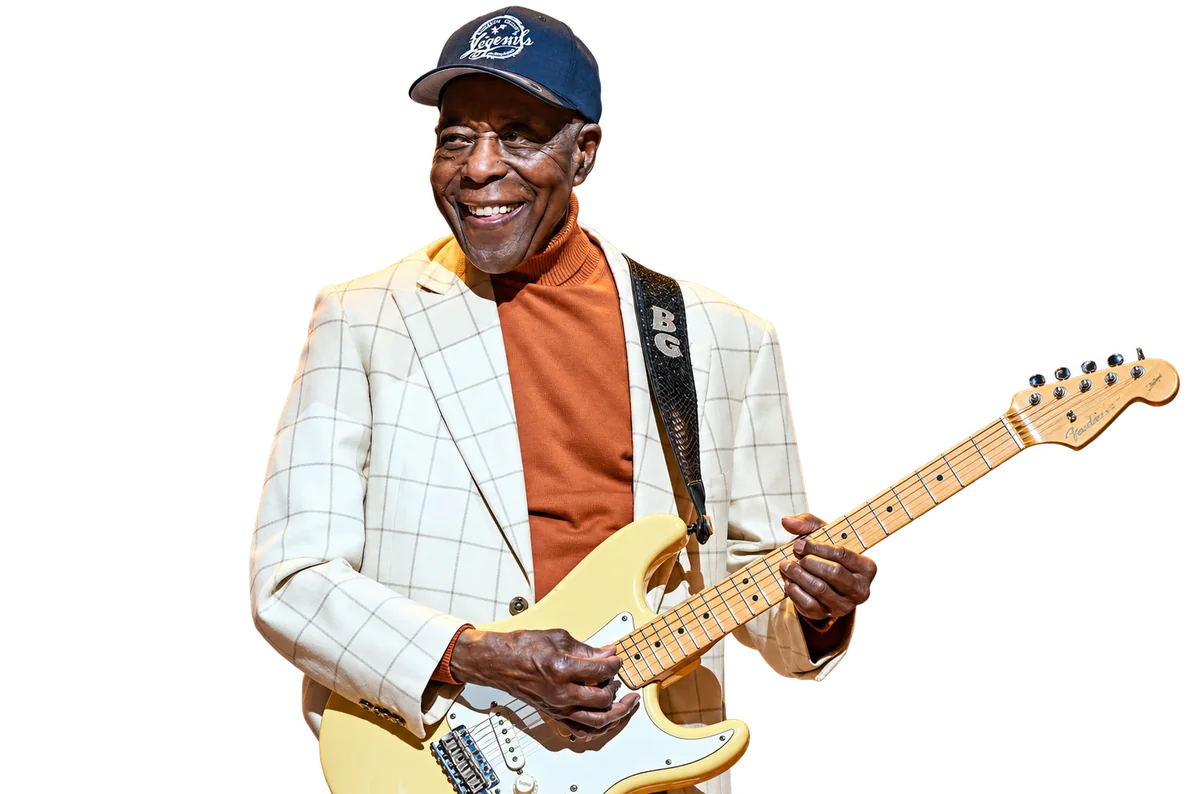
Louisiana beginnings and the move north
George “Buddy” Guy was born on July 30, 1936, in Lettsworth, Louisiana, into a sharecropping family. His earliest instruments were homemade, and his interest in the guitar developed through the music he heard around him and on records. B.B. King offered one model of expressive playing; Guitar Slim offered another lesson in how a musician might turn a performance into an event. Guy eventually combined an exacting interest in sound with a willingness to take physical and musical risks in front of an audience.
He played around Baton Rouge before moving to Chicago in 1957. The city brought him into contact with Muddy Waters, Otis Rush, Magic Sam and a dense network of clubs where a guitarist had to establish an identity among powerful contemporaries. His high, urgent singing and sharply articulated guitar lines helped him do so. Magic Sam helped him reach the Artistic label, an affiliate of Cobra, where Willie Dixon produced his early singles. Those records did not create an immediate national breakthrough. They began a recording career whose wider recognition would arrive much later than his influence among other musicians.
Chess records and a partnership with Junior Wells
Guy joined Chess after Cobra’s collapse. His own singles included “First Time I Met the Blues,” “Let Me Love You Baby,” “When My Left Eye Jumps” and “Stone Crazy.” The records introduced a guitarist who could make a short phrase feel unstable, then resolve it with a sudden bend or clipped response. His voice had a comparable intensity. He could sound close to breaking without abandoning control of the performance, creating a tension that became central to his musical personality.
Chess also employed him as an accompanist for artists including Muddy Waters, Howlin’ Wolf and Koko Taylor. Those sessions required responsiveness to another singer’s needs. His long association with Junior Wells developed the same skill in a more sustained partnership. On Wells’ 1965 Delmark album Hoodoo Man Blues, Guy’s guitar works inside the band’s pulse rather than occupying every available space. The record connected their Chicago club experience to the growing album audience. It also established that Guy’s flair as a soloist was compatible with the patient, collaborative work needed to make a small blues group sound complete.
Albums, touring and the independent years
A Man and the Blues, released by Vanguard in 1968, gave Guy more room as a leader. Other albums followed, and his work with Wells continued through projects such as Buddy Guy and Junior Wells Play the Blues in 1972. Their partnership was flexible enough to encompass different arrangements and audiences. They could bring a club repertoire to festival and rock stages while retaining the exchange between Wells’ harmonica, Guy’s guitar and their contrasting voices.
Guy’s reputation among rock guitarists grew faster than his access to a stable American recording career. Eric Clapton, Jimi Hendrix and Stevie Ray Vaughan were among the musicians influenced by his sound and performing approach. During the 1970s and 1980s, touring and European recording opportunities remained particularly important. Alligator brought the electric Stone Crazy! and the Wells duet set Alone & Acoustic to American listeners after their origins with the French Isabel label. Their contrast is revealing: Guy could sustain a performance through amplified intensity or through the exposed detail of an acoustic exchange. His range extended well beyond the dramatic electric gestures for which he was best known.
Stone Crazy! offered a particularly concentrated example of his electric quartet playing. Recorded in Toulouse, France, on October 31, 1979, it featured his brother Phil Guy on second guitar, J.W. Williams on bass and Ray “Killer” Allison on drums. The extended studio performances allowed the band to follow his changes of intensity instead of compressing every statement into a short single. Alligator’s later American issue made those performances more accessible at a time when his domestic record opportunities were limited. The album stands apart from the earlier Chess single called “Stone Crazy”: the shared title links two periods of his career, but they are distinct releases.
A commercial breakthrough and new directions
Damn Right, I’ve Got the Blues, released in 1991, changed the scale of Guy’s career. Eric Clapton, Jeff Beck and Mark Knopfler appeared as guests, but the central attraction remained Guy’s voice and guitar. The album reached a larger record-buying audience, earned gold certification and brought his first Grammy. Feels Like Rain and Slippin’ In continued the renewed success, giving him a sustained public platform after decades of admiration within the music business.
The following years did not settle into a single formula. Sweet Tea, recorded in Mississippi, explored a heavier, sustained electric atmosphere. Blues Singer, in 2003, returned to acoustic material associated with musicians such as Son House, Skip James and John Lee Hooker. Later albums included Living Proof, Born to Play Guitar, The Blues Is Alive and Well and The Blues Don’t Lie. These releases connected older blues forms to different producers, guest musicians and recording textures. Their variety makes his later career more than a series of retrospective appearances: the guitar continued to be a means of trying out contrasting sounds and emotional temperatures, with the singing directing the shape of each performance.
Legends, recognition and a continuing example
Guy opened Buddy Guy’s Legends in Chicago in 1989. The club became an important part of his relationship with the city, presenting other blues musicians as well as his own performances. It gave his international career a continuing local address and provided a setting in which listeners could hear established players alongside younger musicians. The practical work of sustaining a venue belongs alongside his recordings in any account of his contribution to Chicago blues.
Recognition included his 2005 induction into the Rock & Roll Hall of Fame, the 2012 Kennedy Center Honors and a Recording Academy Lifetime Achievement Award in 2015. His later recording career continued through Ain’t Done with the Blues, which won the Grammy for Best Traditional Blues Album in 2026. Guy’s influence can be traced in the wide dynamic range of blues rock guitar: soft passages interrupted by sharp attacks, distortion used for expressive emphasis, and solos shaped like a singer’s rising argument. Equally significant is his example as a performer able to move between accompaniment and confrontation. The exuberance rests on a long education in listening, from Louisiana musicians to the singers and bandleaders of Chicago’s clubs and studios.