


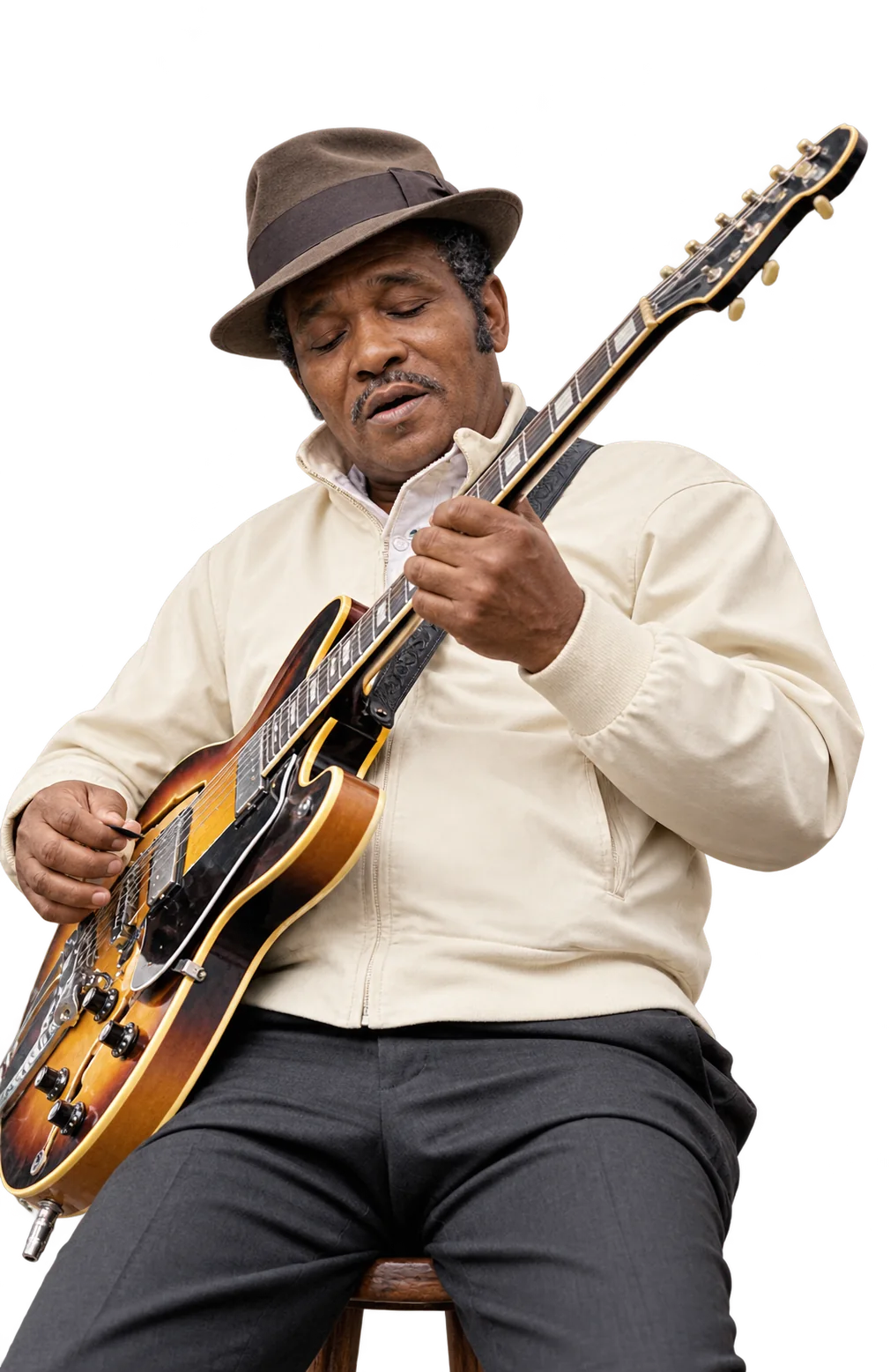
A family band and a new city
Born in Byhalia, Mississippi, in 1926, Dave Myers came from a musical family. Both parents played, and his father performed at local gatherings to help support the household. Dave and his younger brother Louis heard music as part of ordinary work and family life before their move north. In Chicago during the early 1940s, they encountered a different environment, with swing and jazz audible alongside the blues that southern migrants brought into the city. Those overlapping sounds became important to the brothers’ developing approach.
In a late interview, Myers recalled watching guitarist Lee Cooper so closely that Cooper eventually invited the brothers inside and helped them study. Other accounts emphasize the influence of Lonnie Johnson. The essential musical result was an interest in more than a raw accompaniment pattern: the brothers wanted rhythmic drive, melodic detail, and a sound that could sustain a small group. Dave took much of the responsibility for the underlying patterns while Louis played lead. That division of labor was already shaping the ensemble that became the Aces.
The Aces and Little Walter’s Jukes
The brothers worked house parties and joined forces with the young harmonica player Junior Wells. With Fred Below on drums, the group became one of the central small bands in Chicago blues. The partnership combined musicians who knew how to make room for one another: Dave’s rhythmic guitar, Louis’ lead playing, Wells’ harmonica, and Below’s jazz-informed percussion. Their music could swing and still carry the intensity expected in a neighborhood blues club. The Aces’ later reputation rests on that collective skill as much as on the individual careers of its members.
In 1952, Little Walter’s success with “Juke” encouraged him to leave Muddy Waters and front a band. He hired the Aces, while Wells joined Waters. The group became known as Little Walter’s Jukes and accompanied him on influential Checker recordings, including “Mean Old World,” “Sad Hours,” “Off the Wall,” and “Tell Me Mama.” Dave’s instrument on those early sides was guitar, even when the part served a bass-like function. The distinction matters when listening to the arrangements: much of their low rhythmic weight came from the interaction of two guitars and Below’s drums.
From rhythmic guitar to electric bass
Myers’ nickname, the Thumper, grew from the physical attack with which he made a guitar carry the beat. Before a drummer was available, he and Louis had to create their own rhythmic foundation. Dave struck and shaped the lower notes to suggest the weight of an upright bass, reinforcing the time with his feet. The method made a small ensemble sound fuller without requiring every musician to play continuously. It also prepared him for the electric bass, which he adopted as that instrument became more common in blues bands.
He was among the early Chicago blues musicians to recognize the possibilities of amplified bass. Its volume and clarity suited clubs in which electric guitars and harmonicas were becoming louder, and it allowed him to carry over the rhythmic authority he had developed on six strings. His later work included sessions and appearances with Otis Rush, Earl Hooker, Roosevelt Sykes, J.B. Hutto, and other bandleaders. The change of instrument expanded his employment while preserving the central feature of his musicianship: a part built to make the entire group move together.
The reunited Aces and the working musician’s life
The original Jukes lineup did not remain intact throughout Little Walter’s career. Louis left, other guitarists entered the band, and Dave’s own work spread across the Chicago scene. The Aces nevertheless reunited for international engagements and recordings, particularly during the European blues touring activity of the 1970s. Chicago Beat draws on French sessions from that period and presents the band as performers in their own right. Touring gave European listeners the chance to hear musicians who had previously appeared mainly in supporting credits on American singles.
Chicago Beat includes guests Jimmy Rogers, Eddie Taylor, Willie Mabon, and Mickey Baker, extending the trio’s sound without obscuring its center. The credits distinguish Dave’s bass from Louis’ guitar and harmonica and Below’s drums and vocals. They make the later Aces a different instrumental arrangement from the two-guitar group heard behind Walter in the early 1950s. The musicians had changed tools and accumulated new experience, yet the partnership still depended on their ability to recognize one another’s phrasing and leave space for a guest’s contribution.
Music did not remove the need for a day job. Myers worked for decades at the Keebler factory, a fact that complicates the easy assumption that participation in celebrated records guaranteed financial security. He was candid about the gap between the help he had given other artists and the recognition or income he received himself. He nevertheless continued to play and teach informally. In the 1990s he sat in with younger Chicago musicians, including Rockin’ Johnny’s circle, bringing the same rhythmic knowledge into rooms whose audiences had not heard the Aces in their original years.
You Can’t Do That and the return to guitar
Myers finally made a full album under his own name with You Can’t Do That for Black Top. Recorded in California in the 1990s, it features Kim Wilson and Rusty Zinn among its musicians. The setting allowed his singing, original material, and guitar to take a place at the front. “Dave’s Guitar Boogie” is especially revealing of the rhythmic six-string style that had made him valuable long before the bass became his principal professional instrument. Other selections draw on the broader blues and rhythm and blues repertoire that had accompanied his working life.
The album gives listeners a different perspective on someone often identified only by a support role. His playing links the small-group swing of the early Aces with the heavier foundation he later supplied on bass. That combination influenced the practical construction of Chicago bands: melodic freedom above a part that made the rhythm clear. Diabetes and serious illness restricted his final years, and he died in Chicago on September 3, 2001. He was the last surviving member of the best-known Aces trio, leaving recordings that reveal how much of a band’s identity can be created by the musician holding its patterns together.