


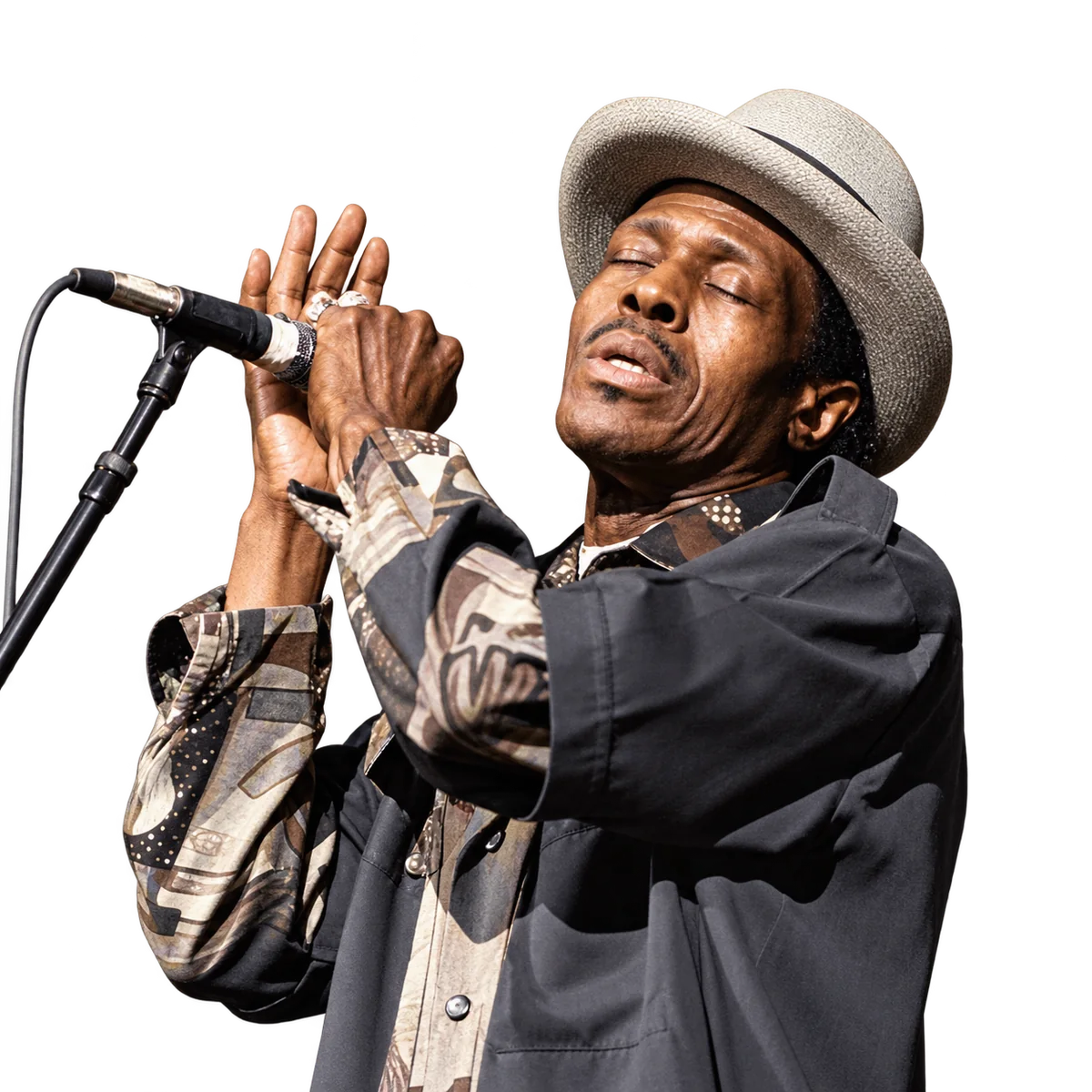
A young musician on the South Side
Junior Wells was born in Memphis in 1934 and moved to Chicago in 1946. He learned harmonica as a child, then sought opportunities among the older musicians working in his new city. Tampa Red and pianist Little Johnnie Jones helped him gain access to performances and musicians he could learn from directly. By his mid-teens he was leading a band that included Louis and Dave Myers, developing the stage confidence and musical appetite that would distinguish his adult career.
His early professional world overlapped with Muddy Waters and Little Walter. Wells worked in Waters’ band as Walter began pursuing his own successful recording career. The association placed him inside one of the strongest ensembles in Chicago blues, where harmonica had an increasingly prominent role. Army service interrupted this period, but Wells continued building a recording identity. His early sides for States, later collected by Delmark as Blues Hit Big Town, included “Hoodoo Man Blues” and “You Better Cut That Out.” These performances introduced both an ambitious instrumentalist and a singer who understood how to turn a forceful short phrase into a personal statement.
Chief singles and a sharper rhythmic style
Beginning in 1957, Wells recorded for Mel London’s Chief and Profile labels. “Little by Little,” “Come On in This House” and “Messin’ with the Kid” became enduring parts of his repertoire. The songs gave him strong identities on record without requiring every performance to sound the same. A slow blues could emphasize the tension in his voice; an insistent riff could support a more clipped and defiant delivery. “Messin’ with the Kid” in particular became a calling card, its compact rhythmic insistence suited to his stage personality.
Wells drew on both Sonny Boy Williamsons, John Lee Williamson and Rice Miller, while developing his own use of short, percussive harmonica phrases. His interest in James Brown’s rhythmic attack helped bring a contemporary funk feeling into a music grounded in Chicago blues. That combination made him more than a successor in an established harmonica line. His voice and instrument shared a vocabulary of abrupt accents, held spaces and sudden answers. At Theresa’s Lounge, where he became a central figure, he could reshape that vocabulary in response to the band and the room, treating a familiar song as material for a fresh performance.
Hoodoo Man Blues and the album audience
Hoodoo Man Blues, recorded for Delmark in 1965, became a turning point. Buddy Guy played guitar, Jack Myers bass and Billy Warren drums. Rather than compiling earlier hit singles, the project gave a working Chicago sound room to unfold across an album. Producer Bob Koester emphasized the value of hearing the music outside the requirements of jukebox singles and radio promotion. The result depended on the musicians’ familiarity with one another as much as on any individual solo.
Wells’ singing, the spaces around his harmonica phrases and Guy’s supporting guitar made the record feel both direct and flexible. The album brought electric blues to listeners arriving through the folk revival, without requiring the band to turn itself into an acoustic revival act. Its continuing importance rests partly on that balance. Wells could make the music immediately intelligible while preserving the looseness and intensity of a club performance. The record also helped establish his partnership with Guy for an international audience. They went on to tour widely, appearing in settings that increasingly connected blues musicians with rock performers and listeners.
Theresa’s, touring and different kinds of partnership
Wells continued recording for Vanguard and other labels while maintaining a strong identity in Chicago. His second major Delmark project, South Side Blues Jam, drew on the atmosphere of Monday nights at Theresa’s. Recorded around the turn of 1970, it brought him together with Buddy Guy, Otis Spann and other experienced players. Wells could improvise words, exchange remarks and let a song develop through the musicians’ responses. “Blues for Mayor Daley” and “I Could Have Had Religion” show how a recording session could retain the immediacy of a live musical conversation.
Live at Theresa’s 1975 offers the complementary experience of hearing him in the actual club. Recorded by Ken Rasek and partly broadcast on WXRT, the performances include guitarists Phil Guy, Byther Smith and Sammy Lawhorn. The repertoire ranges from “Little by Little” and “Messin’ with the Kid” to Little Walter’s “Juke.” Wells’ remarks between numbers help convey his relationship with the audience. In other settings, his work with Buddy Guy moved through projects such as Buddy Guy and Junior Wells Play the Blues and the spare duet performances released as Alone & Acoustic. The reduction in instrumentation exposed how much their partnership depended on timing and mutual recognition.
Harmonica company and the final recordings
Harp Attack!, released by Alligator in 1990, placed Wells alongside James Cotton, Carey Bell and Billy Branch. The project assembled distinct musicians rather than treating Chicago harmonica as one uniform style. Wells brought his own vocal attack and rhythmic economy to that company, while the presence of Branch connected an established generation with a younger musician who had learned directly from it. It was a particularly clear example of influence taking place through shared performance, with differences preserved rather than flattened.
On Harp Attack!, Wells sings and takes the solos on “Keep Your Hands Out of My Pockets” and “Somebody Changed the Lock.” His own “Broke and Hungry” gives Billy Branch a second solo, making the exchange between generations audible within one performance. Michael Coleman’s guitar, Lucky Peterson’s piano, Johnny B. Gayden’s bass and Ray “Killer” Allison’s drums hold the session together. Those supporting roles matter: the four featured harmonica players can vary their phrasing because a coordinated band keeps the rhythmic ground secure.
His later Telarc period included Better Off with the Blues, Everybody’s Gettin’ Some and Come On in This House. The latter continued his interest in placing his voice among different instrumental personalities. He kept touring until serious illness curtailed his work in 1997, and he died on January 15, 1998. The recordings left several complementary portraits: the young singles artist, the tightly focused leader of Hoodoo Man Blues, the conversational presence at Theresa’s and the experienced partner in later collaborations. His influence lies in that breadth as well as in harmonica technique. He showed how a short instrumental response, a spoken aside or a sharply placed vocal entrance could direct a band and make the audience feel addressed personally.