


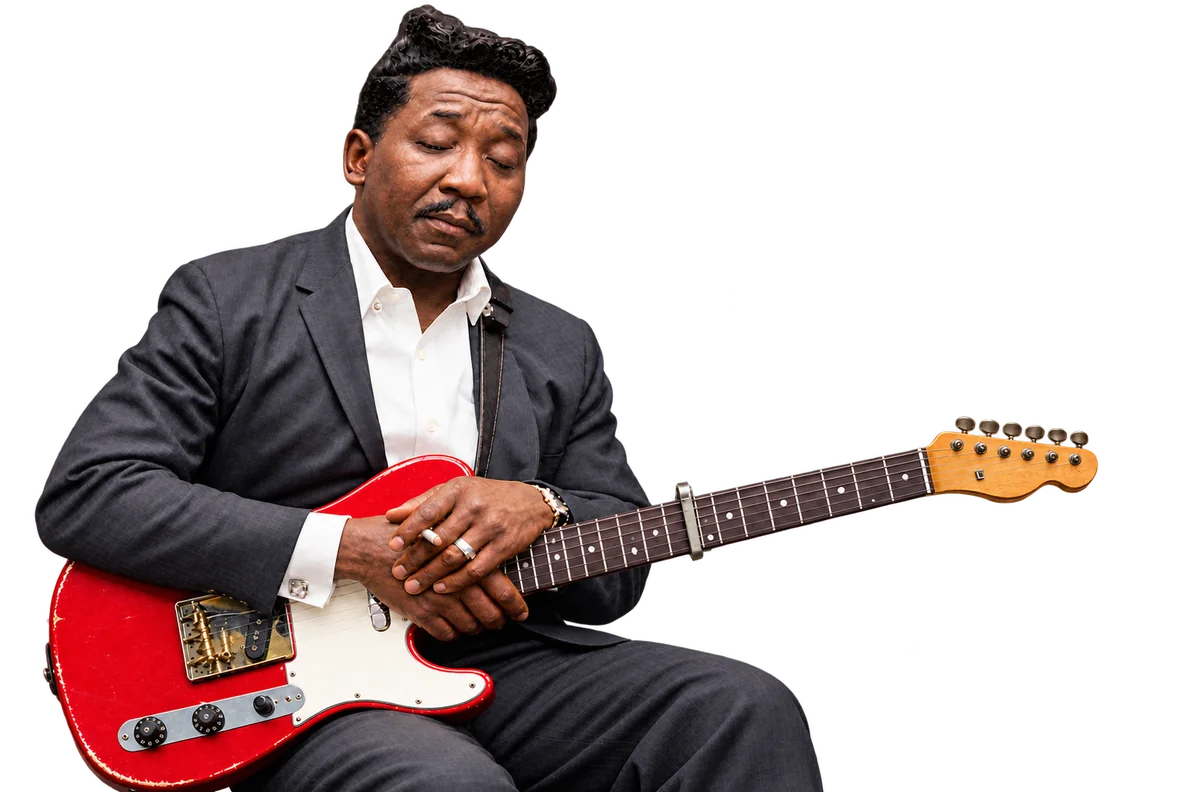
Mississippi music before Chicago
Before he became Muddy Waters, McKinley Morganfield grew up in the Mississippi Delta with his grandmother, Della Grant. The nickname began with his childhood fondness for mud; music came from a much wider world than the name suggests. Around the Stovall Plantation near Clarksdale, he heard local blues players, string bands, church singing and records. He began on harmonica and took up guitar, absorbing the slide playing and vocal force of Son House alongside the music of Robert Johnson and Robert Nighthawk.
Morganfield worked as a tractor driver and played for local gatherings, including performances with fiddler Henry “Son” Sims. He also ran a juke joint at his house. These settings joined music to dancing, food and neighborhood sociability, a relationship that remained central to his later performances. In 1941 and 1942, Alan Lomax and John Work III recorded him at Stovall for the Library of Congress and Fisk University fieldwork project. “I Be’s Troubled” and “Country Blues” caught a musician who already had a repertoire and a recognizable musical personality. Hearing himself played back encouraged him to imagine a professional future beyond plantation work.
Finding an electric voice
Waters moved to Chicago in 1943. Factory employment paid the bills while house parties and neighborhood engagements gave him places to play. Amplification helped his guitar carry through crowded rooms, but the change was more than an increase in volume. The ringing slide phrases and emphatic singing of his Mississippi performances began to interact with the rhythmic demands of a city band. His southern musical background remained audible as the setting and the ensemble changed around it.
An early Columbia session did not immediately establish him commercially. His association with Aristocrat Records proved more consequential: “I Can’t Be Satisfied” and “I Feel Like Going Home,” released in 1948, gave him a breakthrough. The lean accompaniment left his voice and slide guitar exposed, making the tension between the two a principal attraction. Aristocrat developed into Chess Records, and Waters’ long relationship with the Chess brothers helped place his music at the center of postwar blues. Records such as “Louisiana Blues,” “Long Distance Call” and “Honey Bee” carried his sound beyond the customers who could hear him in person.
The band and the Chess songbook
During the early 1950s, Waters assembled a band whose members were distinctive musicians in their own right. Jimmy Rogers brought guitar parts that complemented rather than crowded his leader; Little Walter made amplified harmonica an assertive melodic presence; Otis Spann supplied piano lines that could strengthen the rhythm or answer the singing. The ensemble’s importance lay in those relationships. Its instruments could pull in different directions while preserving the authority of the voice at the center.
Willie Dixon contributed several of the songs that became inseparable from Waters, including “Hoochie Coochie Man,” “I Just Want to Make Love to You” and “I’m Ready.” Their memorable arrangements made room for swagger, suspense and humor. Waters could hold a pause, lean behind the beat or let a repeated phrase gather force without losing the listener. “Mannish Boy” and “Got My Mojo Working” became further essentials of his performing identity. His bands also provided valuable experience for musicians including James Cotton and Junior Wells. Changes in personnel renewed the sound without erasing the combination of southern vocal weight and coordinated electric accompaniment that audiences associated with him.
New audiences and changing records
Waters toured England in 1958 and appeared at the Newport Jazz Festival in 1960, reaching listeners beyond the Black club circuit that had sustained his career. The Newport performance became an influential live album, bringing the excitement of the band to an audience discovering electric blues through festivals and records. British musicians were especially receptive. The Rolling Stones took their name from his “Rollin’ Stone,” an unusually direct sign of how a Chicago blues record could shape a younger band’s identity.
His recordings during the 1960s explored several ways of addressing that expanding public. Folk Singer, released in 1964, placed his singing in an acoustic setting with Buddy Guy among the accompanists. Its quieter framework highlighted the size and flexibility of a voice often associated with amplified bands. Electric Mud, in 1968, moved into psychedelic arrangements, reflecting the record industry’s attempts to connect established blues musicians with rock audiences. These different records reveal the range of settings in which Waters’ voice could be presented. They also mark a period when his influence on younger musicians was becoming more commercially visible than many of his own new singles.
The final band and a lasting repertoire
In the 1970s, Waters continued touring with musicians who understood both the rhythmic discipline and the dramatic freedom his songs required. Pianist Pinetop Perkins and, later, guitarist John Primer belonged to that continuing band history. Johnny Winter helped renew his recording career with Hard Again in 1977, followed by I’m Ready and further releases. The sessions returned attention to his force as a singer in an electric blues ensemble. The renewed success was substantial: these were major late-career records, made by an artist still capable of commanding a band rather than simply revisiting old successes.
Hard Again brought together Johnny Winter and Bob Margolin on guitar, James Cotton on harmonica, Pinetop Perkins on piano, Charles Calmese on bass and Willie “Big Eyes” Smith on drums. The personnel joined members of Waters’ working band with musicians who knew his language closely. The new “Mannish Boy” became a particularly striking opening statement, with the ensemble answering the voice rather than competing with it. Muddy “Mississippi” Waters Live followed in 1979, and King Bee in 1981 completed his sequence of Blue Sky studio albums. The releases preserved both the force of his touring music and the concentration of his later studio performances.
His performance of “Mannish Boy” in The Last Waltz brought that command to another broad audience. Waters died in Westmont, Illinois, on April 30, 1983. He entered the Blues Hall of Fame in 1980 and the Rock & Roll Hall of Fame in 1987. His influence survives both in famous adaptations and in everyday blues performance: the spaces left for a singer, the conversation between guitar and harmonica, and the ways a band can make a familiar phrase feel newly urgent. His repertoire remains a working language for Chicago musicians as well as a foundation of blues-based rock.