


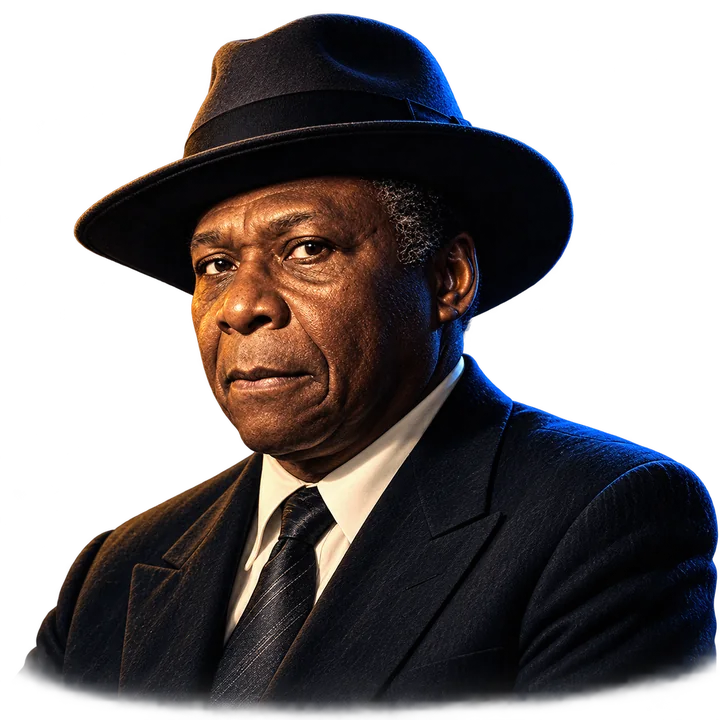
Mississippi, Arizona, and a move toward music
Byther Smith grew up in Monticello, Mississippi, after losing both parents in early childhood. Relatives raised him, and gospel was part of his early musical environment. Before establishing himself as a professional musician, he spent time in Arizona and pursued amateur boxing. Those experiences later entered accounts of his forceful performing style, although the music itself depended on more than a fighter’s determination. His singing could be blunt and exposed, while his guitar supplied cutting phrases that answered the words rather than smoothing away their tension.
He moved to Chicago in the 1950s and entered a scene with many competing approaches to electric blues. Otis Rush became an important musical reference, particularly the sustained emotion and tightly focused guitar sound associated with the West Side. Smith also worked with established singers and harmonica players, gaining experience in accompaniment before making a sustained album career under his own name. His early progress was built through club jobs, short recordings, and the practical need to keep working, rather than through a single breakthrough record that immediately established national recognition.
Theresa’s Lounge and the early singles
Smith became closely associated with Junior Wells and Theresa’s Lounge, one of the South Side’s important working blues rooms. Wells’ singing and harmonica demanded a guitarist who could keep the groove firm and respond quickly to changes in mood or pace. Smith also worked with Otis Rush, Big Mama Thornton, and George “Harmonica” Smith. Those jobs put him in different kinds of ensembles, from a familiar neighborhood setting to performances built around a visiting artist. His identity as a frontman developed alongside this continuing work in support of others.
The early singles included “Champion Girl,” “Thank You Mr. Kennedy,” “Money Tree,” and “So Unhappy.” They show interests broader than one standard blues lament, with room for topical references, rhythm and blues, and personal grievance. Some of this material later returned on albums or compilations, giving a wider audience access to recordings that had first circulated in small editions. The gaps between releases are part of the chronology: a long performing career could exist before an artist had a widely available LP, and Smith was already an experienced professional when that opportunity came.
Wells’ Live at Theresa’s 1975 offers a recorded glimpse of that working environment. Smith is one of the guitarists heard across the album, along with Phil Guy and Sammy Lawhorn. Ken Rasek recorded the performances, some of which were broadcast on Chicago station WXRT. The selection includes “Snatch It Back and Hold It,” “Messin’ with the Kid,” and “Come On in This House.” Wells’ spoken exchanges are retained with the music, preserving the context in which an accompanist had to keep listening even between the songs.
The Grits sessions and an album audience
In July 1981, Smith recorded sessions that supplied material for Tell Me How You Like It on Grits. Delmark later assembled an expanded selection as Hold That Train. The distinction between session date and later issue is important to the album’s place in his career. These performances belong to an earlier stage than the Delmark releases that first brought many listeners to his name. With a compact guitar, bass, and drums framework, the music puts his voice and sharp treble guitar attack close to the center of the sound.
Selections associated with these sessions include “Walked All Night Long,” “This Little Voice,” “Come On in This House,” and “So Unhappy.” The program mixes familiar blues material with songs that emphasize Smith’s own personality. International issues of related recordings helped build his reputation outside the United States. Addressing the Nation with the Blues for JSP and the material circulated as Gritty Soul and Housefire widened that audience further. The album titles themselves suggest the range he wanted: private complaint could stand beside a broader statement, with the vocal carrying an argument rather than simply setting up another guitar solo.
Bullseye, Delmark, and songs with a point of view
I’m a Mad Man on Bullseye paired Smith with a fuller production that included Ron Levy and the Memphis Horns. The arrangements gave his singing and guitar more instrumental company while retaining the urgency of his delivery. Delmark’s Mississippi Kid followed in 1996, with All Night Long in 1997. On those records he had room to develop material beyond the short-form single. His songwriting could be accusatory, humorous, uneasy, or reflective, often placing ordinary conversational language inside an arrangement shaped by familiar Chicago blues forms.
All Night Long includes “Something’s Wrong with This Picture,” “Daddy’s Gone,” “Daddy, You Got a Son,” and “Is He White or Is He Black?” The titles point toward family relationships, suspicion, and social observation. Keyboard and horn contributions broaden the sound, with Malachi Thompson credited for horn arrangements and trumpet. Smith’s guitar remains direct and uncluttered, supplying a contrasting edge against the larger backing. Reviews differed on how far the music moved beyond its models, but even critical accounts recognized the particularity of his lyrics. His strongest identity came from the combination of that writing with a vocal delivery that rarely sounded detached from its subject.
Later studio work and Blues on the Moon
Smith continued recording in the new century with Smitty’s Blues and Throw Away the Book for Black & Tan. The latter, released in 2004, includes his own songs alongside Jimmy Dawkins’ “All for Business” and Willie Dixon’s “Close to You Baby.” Roel Spanjers contributes piano and Hammond organ. The combination links Smith’s individual songwriting to musicians and songs from the wider Chicago tradition. His new material continued to favor direct titles and sharply stated situations, including “The Man Wants Me Dead” and “I Don’t Like to Travel.”
Blues on the Moon: Live at the Natural Rhythm Social Club returned him to the setting that had shaped so much of his career: a working Chicago venue with a band responding to a live audience. Issued by Delmark on CD and DVD, it includes performances of “If You Love Me,” “Give Up My Life for You,” “Hard Times,” and “Monticello.” Smith died in 2021. His recordings preserve a musician whose influence was carried through club employment and the guitar chair behind Wells, as well as through his own catalog. The later albums make the earlier apprenticeship audible while giving his individual words and voice the space they had taken decades to receive.