


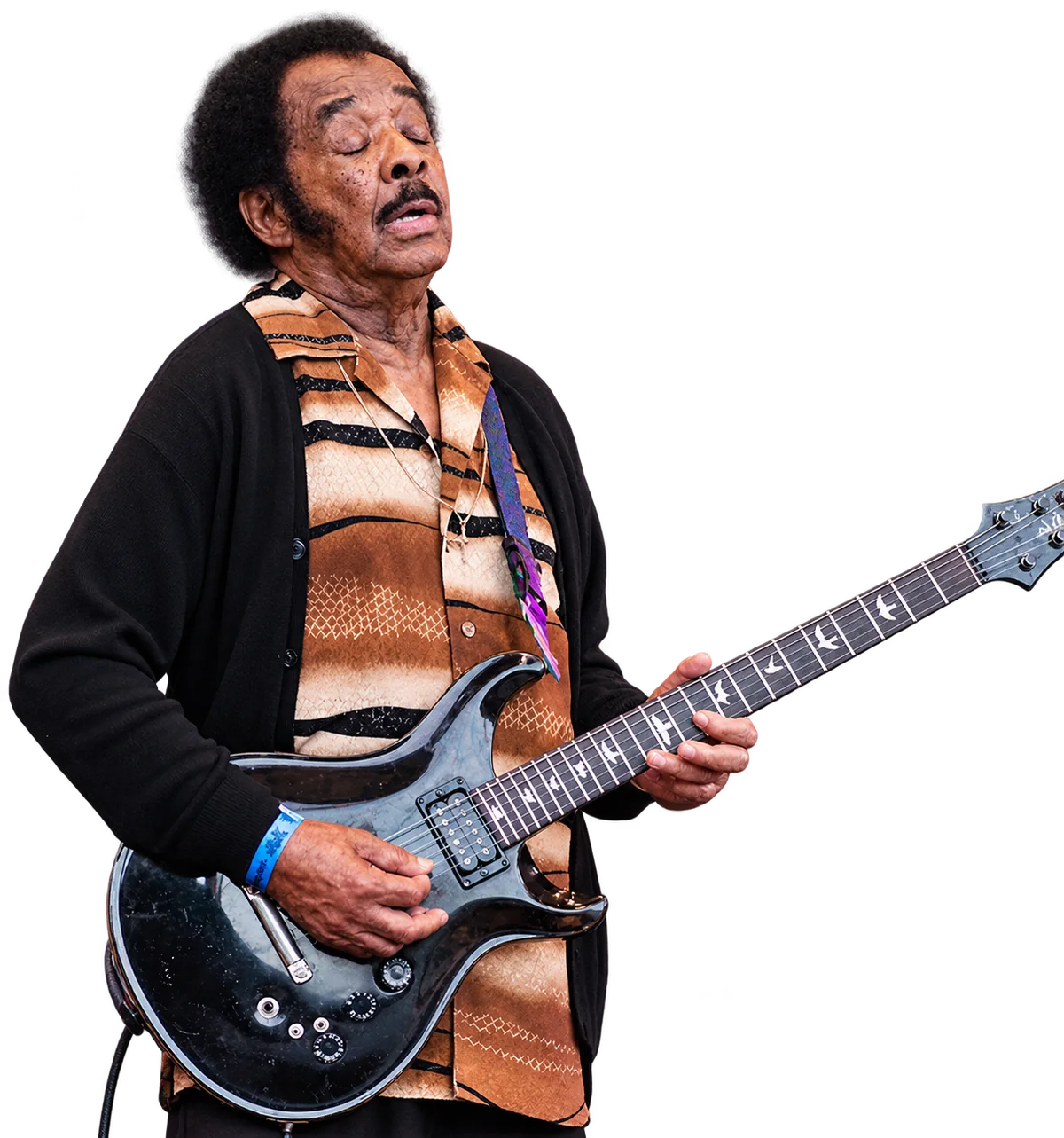
From Holly Springs to Chicago
Jimmy Johnson was born James Thompson in Holly Springs, Mississippi, in 1928. He grew up in a large family and worked in the cotton fields while still a child. Music offered an alternative to the limits he saw around him, but his earliest singing was in church and gospel groups rather than in a blues club. He sang with the United Five in Memphis, and after moving to Chicago in 1950 he continued gospel work with the Golden Jubilaires. The sustained high notes and emotional intensity associated with his later blues singing had roots in that experience.
His younger brothers Syl and Mac entered professional music before he did. Syl became a successful soul singer, while Mac played bass with Magic Sam. Jimmy initially earned his living as a welder, keeping music alongside other work. Living near Magic Sam placed him close to a guitarist whose approach was helping reshape Chicago blues. Johnson’s own development nevertheless took time. He began performing professionally in 1959, entering a scene in which blues, gospel, popular rhythm and blues, and soul were closely connected through musicians and audiences.
Soul bands and a return to blues
Johnson worked with musicians including Magic Sam and Freddie King, but the commercial opportunities in soul and rhythm and blues led him toward that repertoire. He spent years playing other people’s hits and leading bands on Chicago’s South and West Sides. The experience gave him an ear for arrangements and for songs whose appeal depended on melody as well as a guitar break. His later blues retained those qualities: the vocal could soar above the accompaniment, and a tune could accommodate more varied harmony without losing its basic rhythmic force.
In 1974 he joined Jimmy Dawkins as rhythm guitarist, a deliberate move back toward blues. Touring Japan with Dawkins and Otis Rush brought him before an international audience and onto Rush’s live Japanese recording. He also played on Dawkins sessions before organizing his own band. Johnson later remembered the welcome in Japan with particular affection. The trip reinforced his sense that listeners abroad paid close attention to the musicianship of Chicago artists, and it helped provide a setting for his own emergence from a long career spent supporting others.
Johnson’s Whacks, North/South, and Bar Room Preacher
Pepper’s Hangout supplies a further view of Johnson near the beginning of his recognition as a blues leader. Producer Ralph Bass recorded the material in 1977, although the album reached listeners later. Its selections include “Same Old Blues,” “Married Woman Blues,” “High Heel Sneakers,” “The Things That I Used to Do,” and “Riding in the Moonlight.” The program places his individual singing inside a recognizable blues and rhythm and blues repertoire. Heard alongside the Delmark and Alligator albums that followed, it captures a musician bringing the experience of years in soul bands into a more concentrated presentation of his own sound.
Alligator introduced Johnson to a broader record-buying audience with four tracks on Living Chicago Blues, Volume 1 in 1978. The anthology offered a cross-section of the city’s working music, and Johnson’s selections made his distinctive singing and songwriting audible beyond local clubs. Johnson’s Whacks followed on Delmark in 1979, with North/South arriving in 1982. The records established him as a bandleader who could combine blues feeling with arrangements reflecting gospel, jazz, soul, and other music he had absorbed during the previous two decades.
Bar Room Preacher, released by Alligator in 1985, brought those elements together in a focused program. Johnson originals including “Happy Home,” “Heap See,” and “Missing Link” sit beside “Cold, Cold Feeling,” “When My First Wife Quit Me,” and “Little by Little.” His guitar uses cleanly shaped melodic lines and stinging accents, while the high, gospel-influenced voice gives a different character to familiar material. Rather than making every performance depend on instrumental force, he could let a sung phrase carry the tension and then answer it briefly on guitar.
Recovery, later records, and recognition
A serious touring accident interrupted Johnson’s career in the late 1980s. He returned to recording and international work, with I’m a Jockey marking an important stage in the comeback. Later albums and appearances continued to make room for the soul background that had always been part of his music. Two Johnsons Are Better Than One brought him together with his brother Syl, allowing listeners to hear two related but distinct approaches developed from the same family and Chicago musical environment.
Recognition accumulated relatively late. Johnson entered the Blues Foundation’s Blues Hall of Fame in 2016, and Living Blues named him its critics’ choice for Blues Artist of the Year in 2021. Those honors followed a long period during which he had been better known to club audiences, fellow musicians, and overseas listeners than to a general American public. His career makes the chronology of recognition worth keeping separate from the chronology of achievement. The singing, arrangements, and guitar identity were already established on the late-1970s and 1980s records, long before the final round of awards and tributes.
Every Day of Your Life and the final years
Johnson returned to Delmark for Every Day of Your Life, a late-career album made when he was ninety. The title track sets a direct message within a funk-tinged arrangement, while the program also includes a solo vocal-and-piano performance of “Lead Me On,” associated with Bobby “Blue” Bland. Two different Chicago bands support the sessions. The piano performance is particularly revealing: it places the emphasis on his phrasing and interpretation, reminding listeners that the voice and song remained central even in the work of a celebrated guitarist.
During the pandemic, Johnson continued reaching listeners through regular livestreams, including performances associated with Delmark’s Riverside Studio. The broadcasts allowed an artist in his nineties to maintain a direct performing relationship when ordinary club work was restricted. He died at his home in Harvey, Illinois, on January 31, 2022, aged ninety-three. His recordings preserve a personal balance of melodic guitar, gospel-shaped singing, and rhythmic flexibility. His influence can also be heard in the continued performance of his songs, including later tributes to “Every Day of Your Life,” and in the example he set for musicians who refused to treat blues and soul as separate compartments.