


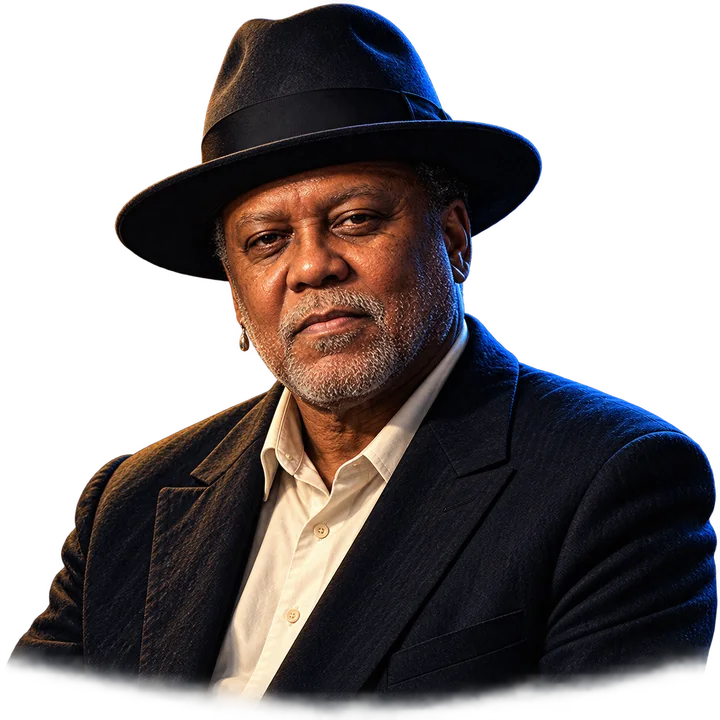
A guitarist from Chicago’s club circuit
Carlos Johnson was born in Chicago on January 17, 1953. He became part of the city’s professional blues circuit in the 1970s, establishing himself through performances and work behind other artists before he had a substantial solo discography. Clubs were the foundation of his reputation. By the time records appeared under his name, he had already spent years taking the music to audiences outside the United States.
Johnson’s work connected him with singers and instrumentalists whose requirements differed considerably. His career included engagements with Valerie Wellington, Otis Rush, Son Seals, Junior Wells, and Billy Branch. Supporting a singer with Wellington’s vocal power was a different assignment from working beside a guitarist such as Rush. That range of experience helped shape a player whose performances could move between close accompaniment and extended lead passages.
An individual approach to the guitar
Johnson is left-handed and is often seen playing a right-handed guitar turned over. His own description of his technique is more varied than that familiar image suggests: he can play instruments strung in either orientation, and in a 2017 interview he said he preferred a left-handed string arrangement when writing. The different configurations affect how a player pulls or pushes a string into a bent note, an especially important expressive device in his music.
Albert King, Otis Rush, and Lefty Dizz were significant points of reference. Johnson admired King’s melodic continuity, the way one phrase seemed to speak naturally into the next. He remembered Dizz as both a serious musician and a humorous entertainer. Their example helps explain why Johnson’s forceful attack does not exclude nuance or a sense of play. The emotional contour of a phrase matters as much as its volume.
His style also reaches beyond a narrow Chicago template. Accounts of his playing describe funk rhythms, jazz phrasing, and an attachment to country blues alongside the electric language of the city’s clubs. These elements give him room to alter the density and direction of a solo. A slow blues can become an extended conversation, while an uptempo number can retain the rhythmic clarity needed by a working dance band.
Overseas audiences and the first solo records
Johnson first toured Japan with Valerie Wellington in 1989. The trip helped establish an audience that would remain important throughout his career. He returned in 2004 to support Otis Rush after Rush’s stroke had limited his ability to play guitar. Johnson later recalled the emotional force of hearing Rush sing in Japan, remembering the performance as one of the high points of his own working life.
His first album under his own name, My Name Is Carlos Johnson, appeared in 2000 through the Argentine Blues Special label. Recorded in Buenos Aires, it reflected a career whose reach had become international before the recording industry had caught up with it. In and Out followed in 2004 on Mr. Kelly’s Records. The geography of these releases was characteristic: a Chicago musician found important recording opportunities through listeners and producers abroad.
Live at B.L.U.E.S. on Halsted, released in 2007, brought the focus back to a Chicago room central to his performing life. Encore! Live at B.L.U.E.S. on Halsted followed. The live format suited an artist accustomed to letting songs develop in front of an audience. Solo tours of Japan in 2007 and 2009 strengthened the relationship first established during his years as Wellington’s accompanist.
Billy Branch and a shared Chicago history
The partnership with Billy Branch offered another outlet for Johnson’s guitar and vocals. He was featured with the Sons of Blues, and the two musicians also made Don’t Mess with the Bluesmen in 2004. Branch’s harmonica and Johnson’s guitar could exchange lead duties without removing either player from the ensemble. Their association extended into educational work, introducing schoolchildren to blues songs, musicians, and song structure.
Johnson participated in Chicago Blues: A Living History and its follow-up, The (R)evolution Continues. The projects brought musicians of different generations together around the development of Chicago blues. Their purpose was expressed in performances of the repertoire itself, with individual singers and instrumentalists taking responsibility for music they knew from professional experience.
He later performed “Out of Control” on Chicago Plays the Stones, the 2018 project produced by Larry Skoller. Chicago musicians interpreted Rolling Stones songs in a reversal of the British band’s long engagement with American blues. Johnson welcomed the recognition while also speaking candidly about the unequal financial rewards available to Black blues musicians and the more commercially successful artists who learned from them. For him, cultural acknowledgment and fair professional treatment belonged in the same conversation.
His approach to teaching makes that concern concrete. Working with Branch, he has introduced children to Muddy Waters and to the construction of a twelve-bar song. The lesson joins a musical pattern to the people who developed it. Johnson has also welcomed younger players who bring rock influences into the music, while insisting that its originators remain audible and receive recognition. His combination of curiosity and historical concern helps explain why a performer with such an individual guitar style has remained invested in collective Chicago projects.
Continuing the exchange with Japan
The Japanese connection developed into an especially clear example of Johnson’s influence through direct musical exchange. Guitarist Hideaki Tanaka moved to Chicago in 1999 and studied Johnson’s approach firsthand. Their joint release Blues – It’s Powerful Stuff appeared in 2026 on P-Vine, backed by Japanese musicians including keyboardist Hiromi Takai, bassist Yohei Kisanuki, and drummer Shigeo “Sanpei” Hirayama.
The album’s seven tracks run for more than an hour, leaving ample room for both guitarists to develop their ideas. The repertoire includes “I Wonder Why,” an extended “I’m Your Hoochie Coochie Man,” and a Jimmy Reed medley. Johnson sings most of the program. Long forms and shifts in pace make the record a useful counterpart to his earlier Chicago club recordings: the setting changes, but the interplay between voice, guitar, and rhythm section remains central.
Johnson has also been candid about how slowly independent projects can move. In 2017 he described Diversatility as unfinished, affected by personal loss, changing lyrics, and the cost of sustaining a band. His career has continued through collaborations and live work as well as albums carrying only his name. The mentorship heard in the Tanaka project gives a concrete measure of that continuing reach: a style developed in Chicago became the basis for another musician’s long study and, eventually, a shared recording.