


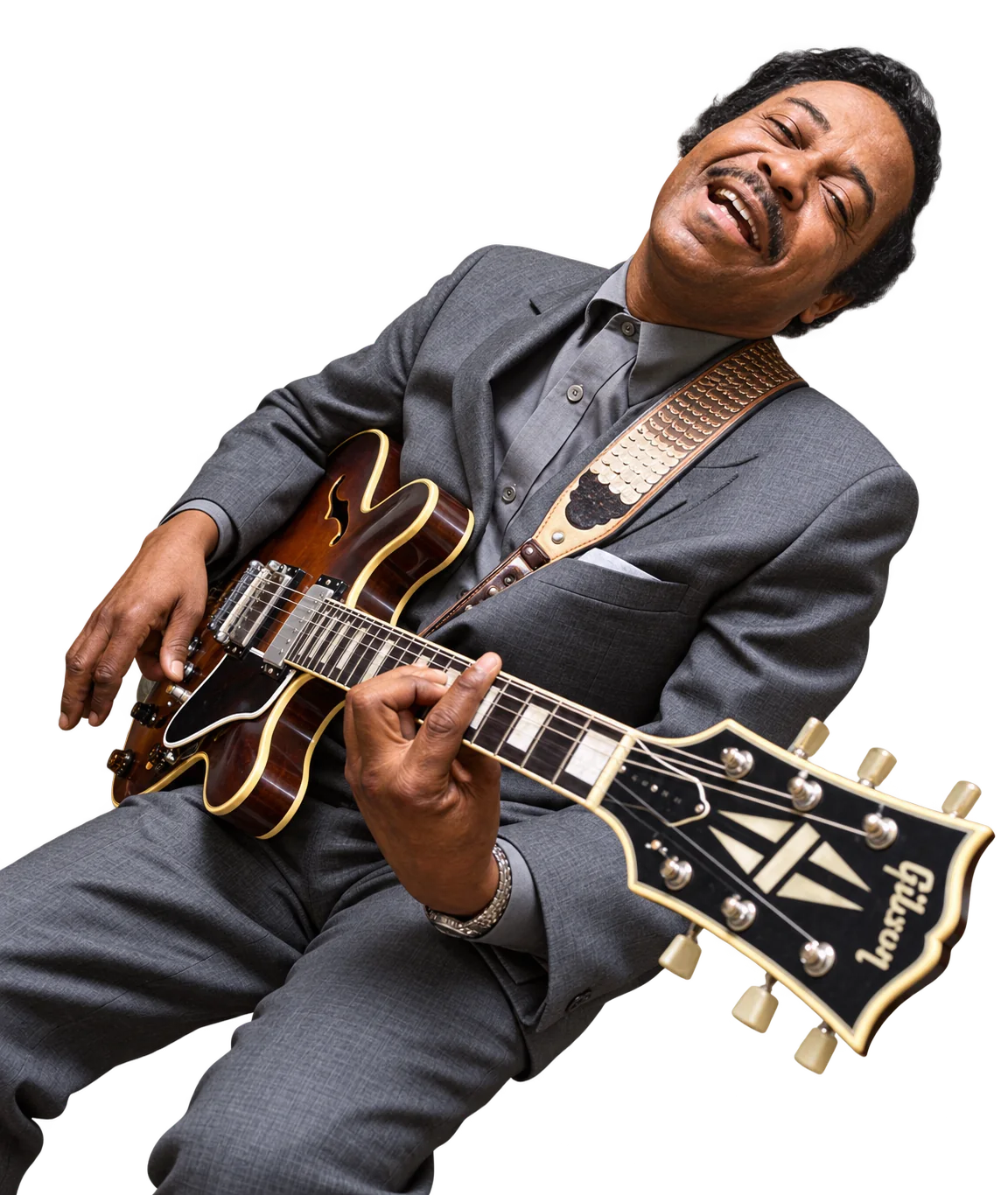
Benoit, Jimmy Reed and the move to Chicago
Eddie Taylor was born on January 29, 1923, in Benoit, Mississippi. He grew up within the Delta’s active blues culture, hearing musicians including Charley Patton and Robert Johnson. A guitarist known as Popcorn helped him learn the instrument. Taylor developed his playing at local juke joints around Leland and Clarksdale and shared his knowledge with Jimmy Reed, a childhood friend. Their later Chicago partnership grew from a connection that long preceded either man’s recording success.
After time in Memphis, Taylor arrived in Chicago in 1949. Snooky Pryor and Floyd Jones were among the musicians with whom he became associated. The city offered an expanding market for electric blues, but working within it required versatility: musicians moved among club bands, recording sessions and different singers’ repertoires. Taylor’s Delta background remained an audible foundation while his timing and harmonic knowledge enabled him to handle a range of settings. His later reputation as an accompanist sometimes obscured the breadth of his playing. He could lead, sing, provide a strong rhythm part or add short, decisive phrases around another musician’s voice.
The Vee-Jay sound and records of his own
Taylor began recording with Reed for Vee-Jay in 1953 and became central to the sound of the resulting hits. “You Don’t Have to Go,” “Honest I Do,” “Ain’t That Lovin’ You Baby” and “Baby What You Want Me to Do” depended on a groove that felt relaxed without losing its internal precision. Taylor’s rhythm guitar helped make that balance possible. The apparent simplicity of the records could conceal how carefully the parts fitted around Reed’s vocal and harmonica phrasing.
His own Vee-Jay debut arrived in 1955 with “Bad Boy,” with Reed contributing harmonica. “Ride ’Em on Down” and “Big Town Playboy” followed, giving Taylor a durable repertoire under his own name. Other singles included “You’ll Always Have a Home” and “I’m Gonna Love You.” These sides presented a singer and guitarist whose authority did not require the borrowed identity of Reed’s accompanist. The performances were compact, with memorable guitar figures and direct vocals. Although they did not achieve Reed’s sales, they continued to circulate among musicians and collectors. Taylor’s work thus entered the blues vocabulary through two routes: a highly successful partnership and smaller-selling recordings that other players valued for their musical character.
Sessions, Floyd Jones and a broader audience
During the 1950s and 1960s, Taylor worked with musicians including John Lee Hooker, Elmore James, John Brim, Sunnyland Slim, Big Walter Horton and Carey Bell. Different leaders required different kinds of attention. A Reed shuffle was not interchangeable with Hooker’s phrasing or an Elmore James performance, and Taylor’s usefulness rested on hearing those differences. His ability to strengthen another artist’s identity made him a frequent choice without turning his own playing anonymous.
The 1966 Testament sessions issued in the Masters of Modern Blues series paired his work with Floyd Jones. Big Walter Horton, Otis Spann and Fred Below were among the accompanists, placing him within a particularly experienced ensemble. Songs such as “Train Fare Home,” “Peach Tree Blues” and “After Hours” helped give the album a wider view of his repertoire than the early singles alone. The project also belonged to a growing market for blues albums that could present musicians at greater length. I Feel So Bad, issued by Advent in 1972, further strengthened the case for Taylor as a leader, giving listeners a more substantial opportunity to hear his guitar and singing together.
European work and the later recording network
International touring became part of Taylor’s career from the late 1960s. He participated in Big Bear’s American Blues Legends ’74 tour and appeared on its associated recordings. Ready for Eddie gave him a full album on the label, with material including “I’m a Country Boy,” “Gamblin’ Man,” “After Hours,” “Playboy Boogie” and “Cross Cut Saw.” The repertoire brought blues instrumentals and songs together, making space for his range rather than presenting him solely through the Reed connection. His occasional billing as Eddie “Playboy” Taylor reflected the lasting association with “Big Town Playboy.”
The instrumentals on Ready for Eddie are especially useful examples of that range. “After Hours” calls for a more spacious approach than the driving “Playboy Boogie,” and the title piece gives the guitar a featured identity without a vocal directing the performance. Alongside them, “You Don’t Love Me” and “Too Late to Cry” keep the album connected to the concerns of his singing repertoire. These choices place the spotlight on a musician comfortable moving between dance music, slower blues and a more open instrumental conversation.
In Chicago he remained available for sessions and club work. Earwig releases credit his guitar on recordings by Sunnyland Slim, Lovie Lee and Big Leon Brooks. On Brooks’ Let’s Go to Town, the detailed personnel identify Taylor on “Tell Me Baby,” while other tracks feature different guitarists. That distinction illustrates how these later albums often assembled performances from a network of players rather than one unchanging band. Taylor also continued appearing at clubs including B.L.U.E.S. on Halsted and John Brim’s Broadway Blues Club. National recognition was only one part of a career sustained by musicians and local audiences who knew the value of his playing.
Final performances and the Taylor family
Still Not Ready for Eddie preserves late performances associated with Antone’s in Austin, Texas. The sessions brought Taylor into company with musicians including Sunnyland Slim, Snooky Pryor, Jimmy Rogers and Luther Tucker. Released after his death, the album places a working bandleader and singer in front of listeners who may previously have known him mainly through other artists’ records. The setting suited the patient phrasing and rhythmic firmness that had been his strengths for decades. He died in Chicago on December 25, 1985.
Music continued within his family. His wife Vera was a singer, and the next generation included guitarist Eddie Taylor Jr., drummer and singer Larry Taylor, and vocalist Demetria Taylor. Demetria’s Delmark debut Bad Girl, released in 2011, explicitly honored the family’s musical inheritance, while her later work continued to connect blues with contemporary Chicago musicians. The family story is one part of Taylor’s influence; the much wider one is the ensemble language he helped establish. Countless bands have played Reed’s songs and Taylor’s own pieces. Beneath those recognizable titles lies a lesson in proportion: rhythm playing can determine the feeling of a record, and a few well-placed notes can make a singer sound more persuasive than a continuous stream of solos.