


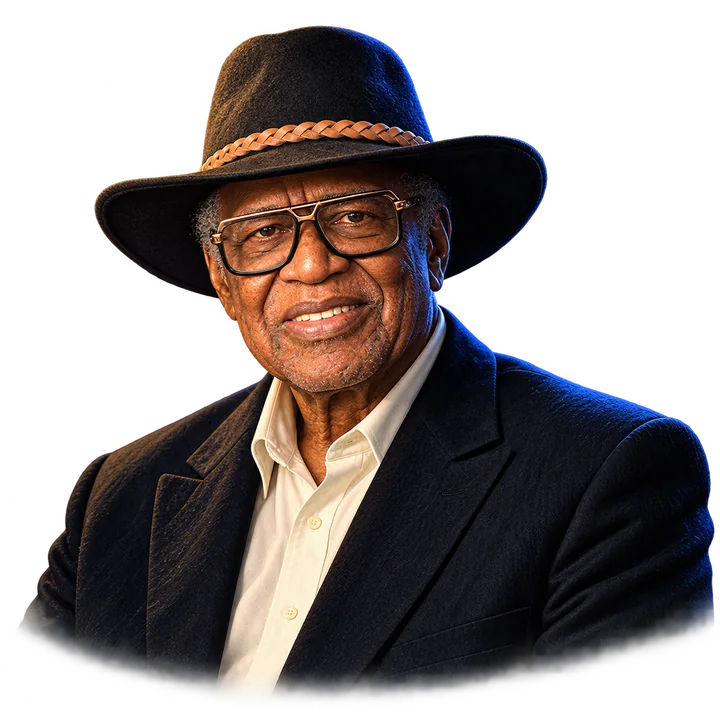
Mississippi roots and a Memphis guitar
Linsey Alexander was born in Holly Springs, Mississippi, on July 23, 1942. His family supported itself through sharecropping. At twelve he moved with his mother and sister to Memphis, where the city opened up a different world of transport, street life, and music. He listened to performers on Beale Street even before he was old enough to enter the clubs.
A family friend known as Otis introduced him to guitar. The friend would demonstrate something, then leave the instrument at the house so Alexander could practice. Eventually the guitar remained with him. His early listening encompassed blues, country, and rock and roll, including Rosco Gordon, Chuck Berry, and Elvis Presley. Singing was central to his interest in music, with guitar developing beside it rather than replacing it.
Chicago and the first working bands
In 1959 Alexander pawned the guitar to help pay for a bus ticket to Chicago, following a young woman he had met in Memphis. He never recovered that instrument. Chicago offered jobs as well as music, and he worked in several occupations while playing at night and on weekends. For much of his adult life, music was one part of earning and maintaining a living rather than his only source of income.
On the South Side he heard singers including McKinley Mitchell, Garland Green, and Otis Clay, as well as Howlin’ Wolf and Lefty Dizz. He bought another guitar and formed the Hot Tomatoes with local players. Talent-show appearances provided early tests of the band. He later formed the Equitable Band, which worked for years at the Launching Pad Lounge and at private functions.
Long engagements gave him time to improve as a singer, guitarist, and entertainer. His relationship with bassist Ron Simmons became especially durable, lasting more than forty years. Alexander valued the connection between a band and the people in front of it. The broad smile and comic stories associated with his later shows grew out of years of learning how to keep a neighborhood room engaged.
Independent records and North Side audiences
Alexander’s move into North Side clubs brought new listeners, including international visitors. Engagements at Kingston Mines and B.L.U.E.S. on Halsted introduced him to audiences who could carry his music home on a CD. He had already spent years playing at Red’s, and an intermediary who heard him there helped secure opportunities farther north.
He began making his own releases, including the 1998 EP Blues ’N’ More, recorded with guitarist Ric Hall. Someone’s Cookin’ in My Kitchen followed, then My Days Are So Long and If You Ain’t Got It. The records became an important part of his livelihood. He sold them directly after performances and treated conversation with listeners as part of a musician’s work, understanding that an audience member might become a record buyer through a personal encounter.
These releases also gave him experience putting his own songs before listeners. His writing often begins with ordinary relationships, grievances, and jokes, then turns them into situations a singer can dramatize. Soul and rhythm and blues remained close to his blues vocabulary. The audience-building work preceded a label breakthrough; it was not a career suddenly created by a first nationally distributed album.
Delmark and three studio albums
An encounter with Delmark engineer Steve Wagner at B.L.U.E.S., where Toronzo Cannon invited Alexander to sit in, helped lead to the label relationship. Been There Done That appeared in 2012. It brought substantially wider distribution to a singer and guitarist who was already familiar to Chicago audiences. Songs such as “Raffle Ticket,” “My Mama Gave Me the Blues,” and “Saving Robert Johnson” made his writing a central attraction.
The Delmark albums also supported touring beyond the audiences he had cultivated in Chicago. Alexander joined the 2013 Chicago Blues Festival tour in Europe, with his band accompanying Nelly “Tiger” Travis and Harmonica Hinds. He returned to France in 2015 with Gaspard Ossikian’s Gas Blues Band. The engagements expanded the reach of the records while drawing on the same experience of leading a club band and supporting other singers. His late international visibility followed years of independent recordings and direct sales to visiting listeners.
Come Back Baby followed in 2014. Alexander led a nine-piece ensemble live in the studio, with Billy Branch guesting on harmonica. New songs included “Little Bit of Soap,” “Booty Call,” “Call My Wife,” and “Too Old to Be a New Fool.” The larger arrangements suited the humorous situations and direct vocal delivery, with room for the band to reinforce a lyric rather than simply wait for the next guitar solo.
Two Cats, released in 2017, continued that approach with horns, keyboards, and a broad cast of musicians. Anthony Palmer, Roosevelt Purifoy, E.G. McDaniel, and Bryant Parker were among the principal players, with guests including Breezy Rodio. “Facebook Woman” brought a contemporary distraction into a familiar relationship complaint; “Starting Monday” considered procrastination; and “Comb Over Blues” turned toward politics. Alexander’s blues writing remained connected to the world around him, including its newer habits and anxieties.
Live at Rosa’s and the later years
Live at Rosa’s appeared in 2020, drawn from two nights at the Chicago club. Simmons played bass, Sergei Androshin added guitar, Purifoy played keyboards, and Big Ray Stewart played drums. The program included Alexander originals such as “My Days Are So Long,” “I Got a Woman,” “Snowing in Chicago,” and “Going Back to My Old Time Used to Be,” alongside songs associated with B.B. King and Junior Wells.
The live setting gave a fuller picture of Alexander’s pacing as an entertainer. A long “Have You Ever Loved a Woman” sat beside more rhythmically buoyant material. His guitar could be piercing and direct, but he also left space for Purifoy and the other players to help shape the set. The album preserved the working band’s relationships as much as the leader’s solos.
Alexander’s son Nicholas became a guitarist and singer, encouraged by his father to develop a complete performing identity. Other younger musicians, including Rodio and Will Jacobs, also passed through Alexander’s musical orbit and later built careers of their own. Illness curtailed his later activity; his final Chicago Blues Festival appearance was in 2022, when he sang from a wheelchair without playing guitar. He died on February 22, 2025, at eighty-two. His recordings preserve an artist whose larger recording career arrived late, after decades spent learning how songs, musicians, and audiences work together.